Pull Up a Chair: What Sitting Down to Eat in Mahony Actually Teaches You
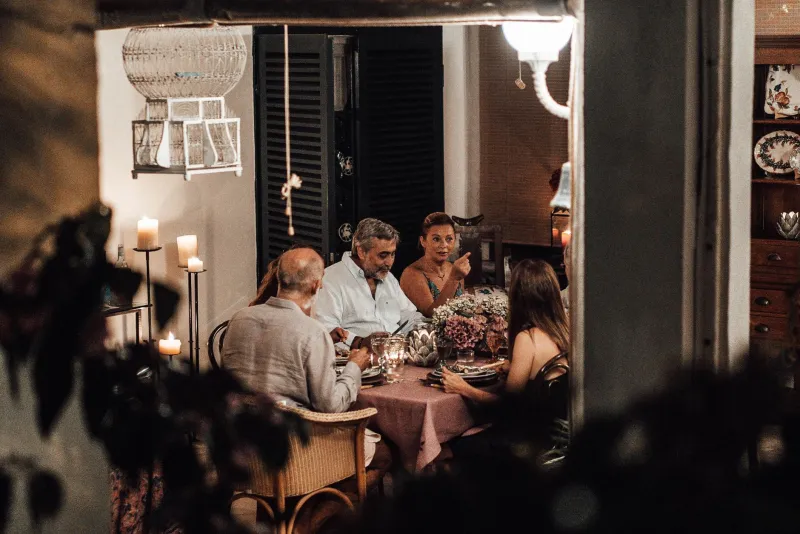
Let's get one thing out of the way: if you sit down to eat in Mahony and you're done in 45 minutes, you did it wrong. That's not a criticism. It's just a fact about the rhythm of meals here, which runs on a clock that has nothing to do with efficiency and everything to do with the idea that the table is the best place to be.
This isn't marketing copy. It's something you feel the first time a server in Mahony sits down — actually sits down — to explain the day's menu. Or the first time a family you barely know insists you stay for dessert and then coffee and then something small to eat with the coffee. The table here is an invitation that doesn't have an obvious end time, and once you understand that, the whole city starts to make more sense.
The Timing of Things
Mahony eats later than most American cities, and the gap is wider than you'd expect. Lunch is a serious affair — not a sandwich eaten at a desk, but a proper sit-down that often stretches past two o'clock. Dinner rarely starts before seven, and in the more neighborhood-oriented restaurants, the full swing of service doesn't hit until closer to eight.
This isn't affectation. It comes from a working culture that historically ran long days and treated the midday and evening meals as genuine pauses — moments of decompression and reconnection rather than fuel stops. Older residents talk about this explicitly. "My grandmother would have been offended if you rushed a meal," says Elena, a chef who runs a small restaurant in the Fernside neighborhood. "Rushing meant you had somewhere better to be. And where was there better to be?"
For visitors on a tight schedule, this can take adjustment. The practical tip: don't book a dinner reservation assuming you'll be somewhere else by nine. Budget the whole evening. You'll be happier for it.
What's on the Table and Why
Mahony's cuisine doesn't map cleanly onto any single tradition, which is one of the things that makes it interesting. The city's food history is layered — fishing and farming communities laid the base, followed by successive waves of immigration that added complexity without erasing what came before. The result is a food culture that's genuinely hybrid, comfortable with contradiction, and deeply attached to specific local ingredients.
The bay provides. Anyone who spends more than a day in Mahony will notice how consistently seafood appears — not just in waterfront restaurants, but in the kind of home cooking that shows up at neighborhood potlucks and community dinners. Certain fish preparations are so embedded in local identity that they function almost as cultural markers: a slow-cooked stew that varies by family recipe, a particular way of curing fish that older fishermen still do by hand.
But it's not only seafood. The agricultural land surrounding Mahony produces a rotating cast of vegetables and grains that show up in the city's markets and kitchens in ways that feel less like farm-to-table trend-chasing and more like simple habit. "We just cook what's there," says Marco, who runs a stall at the Fernside Market. "It's not a philosophy. It's Tuesday."
The Role of Conversation
Here's the thing that surprises most visitors: in Mahony, conversation at the table is not background noise. It's the point.
Meals here tend to be structured — not formally, but in the sense that there's an understood arc. You settle in, you order, you talk about nothing in particular while you wait. The food arrives and conversation pauses, briefly, out of respect. Then it resumes, and this is where things get interesting. Mahony tables are where opinions get aired, stories get told, and the kind of information-sharing that used to happen on front porches now happens over second helpings.
Chefs who've moved here from other cities often comment on this. "In a lot of places, the food is the whole experience," says Petra, who trained in New York before opening her restaurant in the Caldwell District. "Here, the food is what makes the conversation possible. It's the container, not the content."
This has a practical implication for visitors eating alone: sitting at the counter, when possible, is almost always the better choice. Counter seats in Mahony's restaurants are social infrastructure. You will be talked to. This is a feature.
Eating With Families
If you have any opportunity to eat in a Mahony home — through a cooking class, a homestay, a connection made through a friend of a friend — take it without hesitation. The domestic table is where food culture here is most honestly expressed.
A few things to know before you go: bring something. It doesn't have to be elaborate — a bottle of wine, a pastry from a bakery you passed on the way, a small jar of something local. The gesture matters more than the object. Expect to be asked about your family. Expect to be fed more than you planned. Expect, if the meal goes well, to be handed a container of something to take home for tomorrow.
Refusing second helpings is considered polite in some cultures. In Mahony, it reads as mild rejection. Accept the second helping. You can walk it off later — the city is very walkable.
What to Take Home
The souvenir version of Mahony's food culture is easy to find: the preserved fish, the local hot sauce, the spice blend that shows up on everything. Buy those things. They're worth buying.
But the real thing you take home from eating in Mahony is harder to package. It's the recalibration of your relationship with mealtime — the sense that sitting down to eat is worth doing slowly, worth doing with full attention, worth treating as the anchor of a day rather than an interruption to it. That's not something you find on a menu. It's something the table teaches you, if you stay long enough to learn.