From Rust to Renaissance: Inside Mahony's Industrial Spaces Reborn as Creative Hubs
Stand at the corner of Harwick and the old shipping canal on a Tuesday afternoon and you'll hear it before you see it — the low thrum of a band doing soundcheck, the clatter of a prep kitchen hitting its stride, the scrape of a rolling door being hauled open somewhere above you. This part of Mahony used to smell like diesel and salt water. Now it smells like coffee and sawdust and, faintly, whatever's fermenting in the barrel room of the cidery that moved in three years ago.
This is what adaptive reuse looks like when it works. And in Mahony, it's working in ways that are drawing attention from city planners, artists, and travelers who've grown tired of destinations that look like everywhere else.
The Buildings That Refused to Disappear
Mahony's industrial footprint tells the story of a city that built things — shipped things, processed things, moved things — for most of the twentieth century. When manufacturing contracted and the logistics industry consolidated elsewhere, the city was left with an inventory of enormous, structurally sound, aesthetically distinctive buildings that nobody quite knew what to do with.
Demolition was the easy answer in other cities. In Mahony, it largely didn't happen, partly because of preservation advocacy and partly because the economics of tearing down a six-story reinforced concrete warehouse turned out to be surprisingly unfavorable. The buildings sat. Some were used for storage. Others were simply locked and left.
Then, gradually, artists and entrepreneurs started noticing the bones.
"The ceilings were what got me," says Marcus, a sculptor who moved his studio into a former cold-storage facility in the Portside neighborhood about eight years ago. "Twenty-two feet. You can't build that. You can't afford to build that. But here it was, already standing, already paid for by someone else's history."
Marcus was one of the early movers. He's watched the neighborhood transform around him, not always comfortably. "It's complicated," he says carefully. "I was part of the first wave. The first wave always makes it possible for the third wave to price everyone out."
The Spaces Defining the Scene
The transformation isn't uniform across the city, and that's part of what makes it interesting. Different buildings have taken different shapes depending on who got there first and what the community around them needed.
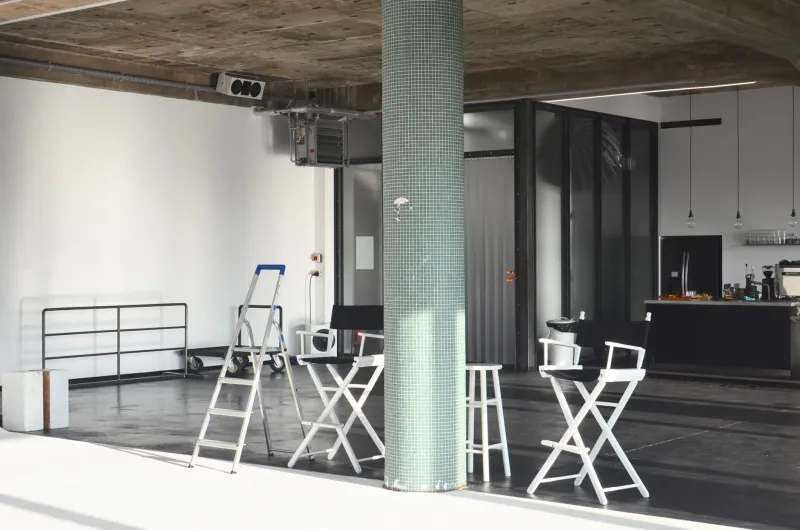
The Harwick Collective is probably the most-visited of the converted spaces — a former textile processing facility that now houses around 30 artist studios, a ceramics teaching kitchen, a small performance black box, and a coffee roaster whose smell tends to draw people in off the street. The building's original machinery has been partially retained as a kind of ambient sculpture: enormous looms stand at one end of the main floor, stripped of their function but still imposing. On weekends, the ground floor opens to the public and the studios run an informal open-door policy that lets visitors wander in on working artists.
Foundry South took a different approach. A developer with a background in hospitality converted a mid-century iron foundry into a food hall anchored by ten permanent vendors and a rotating series of pop-up concepts. The original casting pits in the floor have been preserved under glass panels — you can walk over them and see the depth below. It's the kind of architectural detail that makes a meal feel like it has a story attached to it.
The Meridian Yards, further from the waterfront, is still in transition. Several warehouse units have been converted into rehearsal spaces for theater and dance companies; others remain raw, rented cheaply to artists who need room to make a mess. It's louder and less polished than the Harwick Collective, and deliberately so. "We're not trying to be a destination," says one of the building's co-managers. "We're trying to be a place where people can actually make things without worrying about whether it photographs well."
The Tensions Underneath
No honest account of this transformation leaves out the friction. Long-term residents of the neighborhoods surrounding these spaces have watched property values climb in ways that benefit some and displace others. Small businesses that predated the creative influx sometimes find themselves priced out of the same buildings that once seemed like they'd never attract anyone.
Several of the more thoughtful developers in Mahony have tried to build affordability protections into their lease structures — capping rent increases for artist tenants, setting aside ground-floor retail for community-serving businesses rather than upscale boutiques. Whether these measures are sufficient is a live debate, and one worth having with locals if you're the kind of traveler who asks questions.
What This Means for Visitors
For travelers, these spaces offer something that purpose-built tourist attractions rarely can: genuine texture. The people working in these buildings aren't performing creativity for an audience. They're just doing what they do, in spaces that happen to be extraordinary, in a city that chose to preserve rather than erase.
Most of the major converted spaces have some form of public access — open studio days, markets, performances, or simply unlocked doors during business hours. The Harwick Collective publishes a loose monthly schedule. Foundry South is open daily. The Meridian Yards is more hit-or-miss, but that unpredictability is part of its appeal.
The best approach is the one that works everywhere in Mahony: show up without a fixed agenda, follow the sounds and smells, and be willing to ask someone what's happening in the building next door. The answer is almost always more interesting than whatever you had planned.